Skip to header Skip to main navigation Skip to main content Skip to footer

Fal Doubles to 16 Billion Dollars: Inference Is Where AI Meets Its Customers

Breadcrumb

  • Home
  • Fal Doubles to 16 Billion Dollars: Inference Is Where AI Meets Its Customers
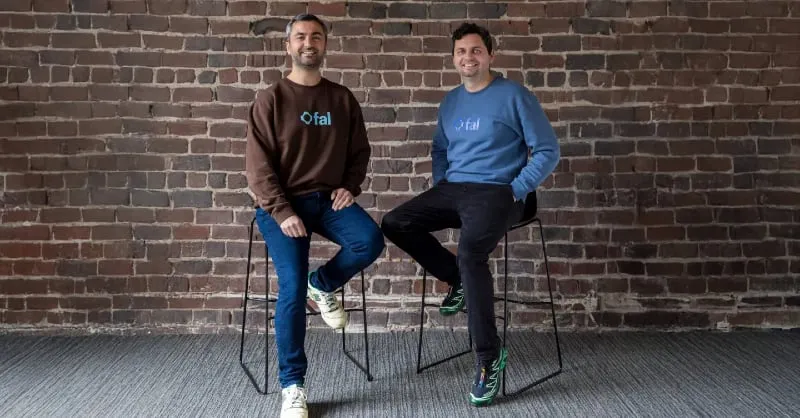
Photograph of Fal co-founders Burkay Gur and Gorkem Yurtseven seated on stools in front of a brick wall, wearing Fal sweatshirts.

Fal, a San Francisco startup that hosts and runs AI video, image, and audio models, has raised 1.3 billion dollars in its latest funding round, TechCrunch reported on November 3. The round was led by Bessemer Venture Partners, with participation from Nvidia, Sound Ventures, and T. Rowe Price, and it values Fal at 16 billion dollars, double its 8 billion dollar valuation in April, according to Bloomberg reporting cited by TechCrunch. Fal announced its Series E and Series F rounds at the same time, noting that a combined 1.65 billion dollars was raised across both, with Sequoia leading the earlier round. The company surpassed 800 million dollars in annualized revenue earlier this year.

That revenue figure is the real story. Fal does not train frontier models. It runs them, a process called inference, for customers who need a trained model to generate an output on demand. The company was co-founded in 2021 by Burkay Gur, a former Coinbase machine learning leader and Oracle engineer, and Gorkem Yurtseven, who was previously a developer at Amazon. Demand has surged in particular from customers relying on open source models, which need a fast and reliable place to run just as much as proprietary models do, but without a single lab's cloud standing behind them.

For builders, this is where the economics of AI now live. Training a model is a large cost paid once. Inference is a smaller cost paid on every request, by every user, forever, and it decides whether a product's margins work at real scale. Fal is not alone in that trade: TechCrunch noted that Baseten, Fireworks AI, and Modal have also been growing rapidly and raising large rounds at higher valuations. It also noted the catch, reporting that gross margins across inference providers remain thin because of the high cost of buying or leasing compute. A 16 billion dollar valuation on thin margins is a bet that volume, efficiency, and being the default host for open models will matter more than margin today.

The same day brought the other half of the production problem: watching what deployed models and agents actually do. CrowdStrike said it will buy Fiddler AI, which makes observability software for monitoring AI agents inside enterprises, and Dreadnode, which automates security testing aimed at finding flaws in AI models, applications, and agents before they go live. CrowdStrike is paying around 400 million dollars for Fiddler AI and about 95 million dollars for Dreadnode, according to The Wall Street Journal reporting cited by TechCrunch. Fiddler, founded in 2018, will become Falcon Observe inside CrowdStrike's Falcon platform, while Dreadnode, founded in 2023, will feed its testing results into Falcon Guardian as security policy recommendations.

Together, the two deals describe the mature phase of building with AI. One company is valued at 16 billion dollars for running models quickly and at scale. Another is spending nearly 500 million dollars so enterprises can evaluate agents before deployment, monitor their actions afterward, and test them for flaws before release. Neither announcement is about a smarter model. Both are about what happens after the model exists, which is precisely where working practitioners spend their time, their money, and increasingly their risk.


Rocky Mountain Madman LLC
AI Funding
Enterprise AI
Multimodal AI
AI Product News
Open Weights

Ai Industry News

Nvidia's Flora Labels Robot Video for 72 Cents an Hour, Not 88 Dollars

Photograph of two humanoid robots, one working alongside a woman in a kitchen and another wearing a white Nvidia hard hat at a work station

Nvidia's GEAR robotics lab has open-sourced Flora, the data engine it uses to train its GR00T humanoid robot models, and the headline number is hard to ignore. Reporting by The Decoder on October 25, drawing on Nvidia's research paper, puts Flora's cost at about 72 cents to label one hour of robot video, compared with roughly 88.49 dollars for OpenAI's GPT-6 Astra. The models are available on Hugging Face, and Nvidia says the system already annotates up to 200,000 hours of video a day across 512 GB300 GPUs in its own training pipeline.

  • Read more about Nvidia's Flora Labels Robot Video for 72 Cents an Hour, Not 88 Dollars

Apollo Says AI Has Paid Off Nowhere Outside Tech: The S&P 493 Are Still Flat

Photograph of the carved stone facade of the New York Stock Exchange building with its gold Stock Exchange lettering.

Apollo Global Management's chief economist has put a number on the suspicion many finance chiefs have been voicing privately. In a note published October 24, Torsten Slok argued that artificial intelligence has delivered, in his words, zero financial payoff to corporate America outside of tech. TechCrunch reported the note on October 25. His test is deliberately plain: strip the Magnificent Seven out of the S&P 500, and the remaining 493 companies show flat profit margins, flat revenue per worker, and no sign in the productivity data that AI is moving the needle yet.

  • Read more about Apollo Says AI Has Paid Off Nowhere Outside Tech: The S&P 493 Are Still Flat

Anthropic Says One Agent Beats Many: Fold Your Subagents Back Into the Loop

Photograph of Dario Amodei.

Anthropic is telling enterprise builders to do the unfashionable thing: use fewer agents. In guidance published October 22 from its Applied AI team, and reported widely on October 25, the company said that across several enterprise deployments a single agent that loads skills and tools only when needed frequently beat both a one-prompt-for-everything design and a fleet of specialised subagents on quality, and often cost less and ran faster. In one comparison the single-agent setup ran about twice as fast as the multi-agent version it replaced.

  • Read more about Anthropic Says One Agent Beats Many: Fold Your Subagents Back Into the Loop

Pagination

  • First page « First
  • Previous page ‹ Previous
  • …
  • Page 6
  • Page 7
  • Page 8
  • Page 9
  • Current page 10
  • Page 11
  • Page 12
  • Page 13
  • Page 14
  • …
  • Next page Next ›
  • Last page Last »

Copyright © 2026 Rocky Mountain Madman LLC - All rights reserved

Developed and Designed by Rocky Mountain Madman LLC