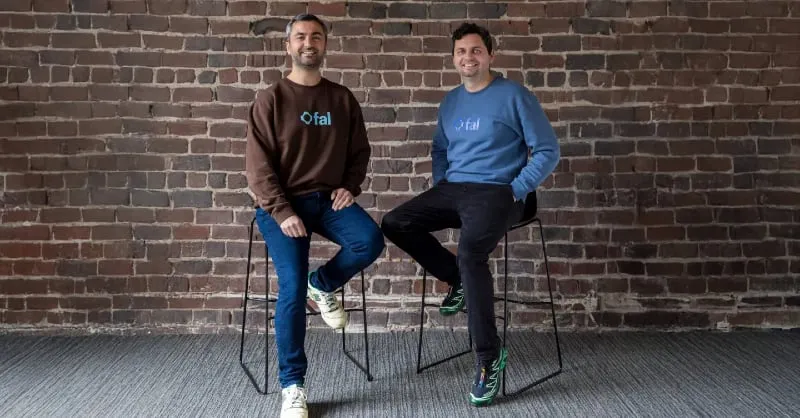
Fal, a San Francisco startup that hosts and runs AI video, image, and audio models, has raised 1.3 billion dollars in its latest funding round, TechCrunch reported on November 3. The round was led by Bessemer Venture Partners, with participation from Nvidia, Sound Ventures, and T. Rowe Price, and it values Fal at 16 billion dollars, double its 8 billion dollar valuation in April, according to Bloomberg reporting cited by TechCrunch. Fal announced its Series E and Series F rounds at the same time, noting that a combined 1.65 billion dollars was raised across both, with Sequoia leading the earlier round. The company surpassed 800 million dollars in annualized revenue earlier this year.
That revenue figure is the real story. Fal does not train frontier models. It runs them, a process called inference, for customers who need a trained model to generate an output on demand. The company was co-founded in 2021 by Burkay Gur, a former Coinbase machine learning leader and Oracle engineer, and Gorkem Yurtseven, who was previously a developer at Amazon. Demand has surged in particular from customers relying on open source models, which need a fast and reliable place to run just as much as proprietary models do, but without a single lab's cloud standing behind them.
For builders, this is where the economics of AI now live. Training a model is a large cost paid once. Inference is a smaller cost paid on every request, by every user, forever, and it decides whether a product's margins work at real scale. Fal is not alone in that trade: TechCrunch noted that Baseten, Fireworks AI, and Modal have also been growing rapidly and raising large rounds at higher valuations. It also noted the catch, reporting that gross margins across inference providers remain thin because of the high cost of buying or leasing compute. A 16 billion dollar valuation on thin margins is a bet that volume, efficiency, and being the default host for open models will matter more than margin today.
The same day brought the other half of the production problem: watching what deployed models and agents actually do. CrowdStrike said it will buy Fiddler AI, which makes observability software for monitoring AI agents inside enterprises, and Dreadnode, which automates security testing aimed at finding flaws in AI models, applications, and agents before they go live. CrowdStrike is paying around 400 million dollars for Fiddler AI and about 95 million dollars for Dreadnode, according to The Wall Street Journal reporting cited by TechCrunch. Fiddler, founded in 2018, will become Falcon Observe inside CrowdStrike's Falcon platform, while Dreadnode, founded in 2023, will feed its testing results into Falcon Guardian as security policy recommendations.
Together, the two deals describe the mature phase of building with AI. One company is valued at 16 billion dollars for running models quickly and at scale. Another is spending nearly 500 million dollars so enterprises can evaluate agents before deployment, monitor their actions afterward, and test them for flaws before release. Neither announcement is about a smarter model. Both are about what happens after the model exists, which is precisely where working practitioners spend their time, their money, and increasingly their risk.