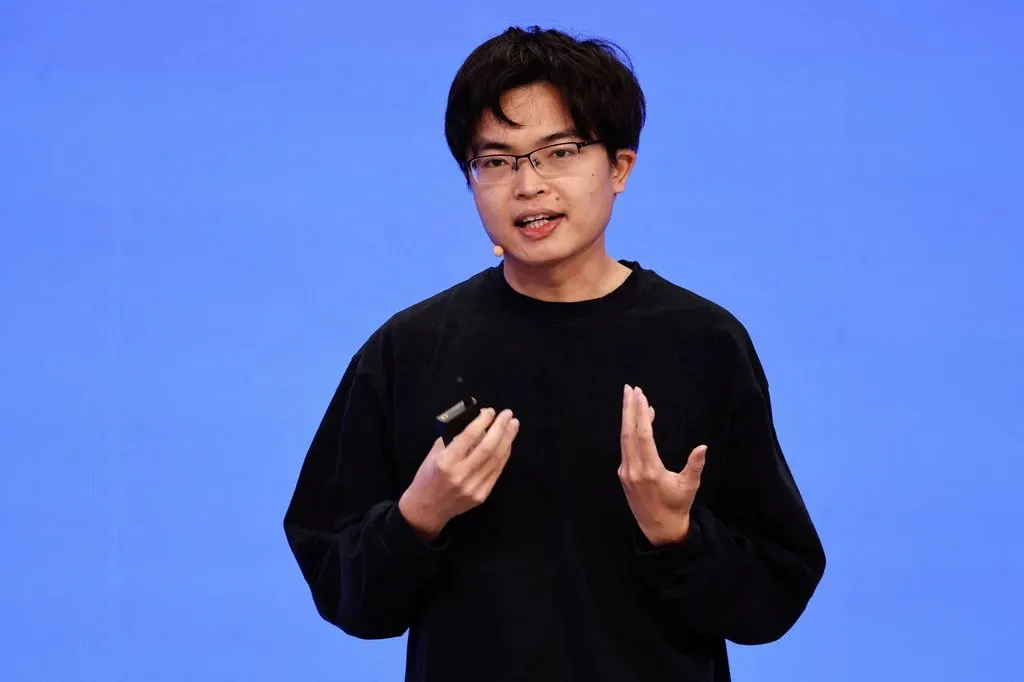
Moonshot AI released Kimi K3.1 Pro on October 23, its most capable 3T-class open-weight model to date. It is not a new base model: it is Kimi K3 put through substantially more reinforcement learning across hundreds of downstream domains. The architecture stays at 2.8 trillion total parameters with 104 billion active per token, a 1 million token context window, and text and image input. K3.1 Pro and a Highspeed variant running two to three times faster are live now on Kimi.ai, the Kimi apps, Kimi Work, Kimi Code, and the Kimi API, at 2 dollars per million input tokens and 10 dollars per million output, a third cheaper than K3. Moonshot says the full weights will be released by November 4.
The benchmark story is strong, with the usual caveats attached. On Terminal-Bench 4.0, Moonshot reports 65.7 percent for K3.1 Pro, ahead of GPT-6 Astra at 58.2 percent and just behind Claude Opus 5.5 at 66.4 percent, though its own model ran inside Anthropic's Claude Code harness. The independent check is more persuasive: Artificial Analysis scores K3.1 Pro at 55 on its Intelligence Index, fourth overall behind only Claude Opus 5.5, Claude Sonnet 5.5, and Muse Wonder Full, and third on GDPval-AA for agentic knowledge work. Moonshot also claims a state-of-the-art 64.4 on OfficeQA Pro v2, and says its internal hallucination stress test saw claim-level errors fall from 23.4 percent on K3 to 8.3 percent, while cautioning that test is designed to provoke errors.
The most unusual part of the launch is what Moonshot deliberately left out. The company says it traced rising vulnerability-research skill in its checkpoints to cyber-related material in the training corpus and the reinforcement learning mix, and removed that data from both stages before the open-weight release, keeping the general coding tasks that make the model useful. On its in-house vulnerability benchmark, a checkpoint trained without those measures solves 90.5 percent of tasks, while the shipped model reaches 81.0 percent. Its stated principle is not to release open weights that extend the absolute frontier of cyber capability, while still raising the defensive capability available to everyone, so more teams can audit code they maintain, legacy systems included. Whether filtered training survives determined fine-tuning after the weights ship is the open question, and Moonshot does not pretend otherwise.
For builders, the practical sequence matters more than the headline scores. A 2.8 trillion parameter model is not something you run on a workstation when the weights land; it is a serious inference deployment. Evaluate through the API now, on your own agent tasks rather than Moonshot's, and treat November 4 as the date the self-hosting and fine-tuning conversation starts. Watch the verbosity, too: Artificial Analysis found the model wordy, using more output tokens per task than its predecessor, so its cost per finished task sits near K3's despite the lower token prices. Cheap tokens that produce long answers are not automatically a cheap agent.
The Kimi release also landed in a week when the plumbing around agents got quieter and more important. OpenAI made its Decisions API generally available on October 22, a bounded-answer endpoint on GPT-6 Luna at 0.10 dollars per million input tokens with no output charge, up to 400 questions per request, and new voice, image, and JSON inputs. The pattern across both stories is the same: frontier capability is being packaged into cheaper, narrower, better-governed pieces. The builders who win the next year will not be the ones who picked the winning model this week. They will be the ones with evaluations good enough to swap models when the next one lands.