Skip to header Skip to main navigation Skip to main content Skip to footer

Meta and Sierra Draft the Personal Agent Protocol, an Open Sign-In Standard for Agents

Breadcrumb

  • Home
  • Meta and Sierra Draft the Personal Agent Protocol, an Open Sign-In Standard for Agents
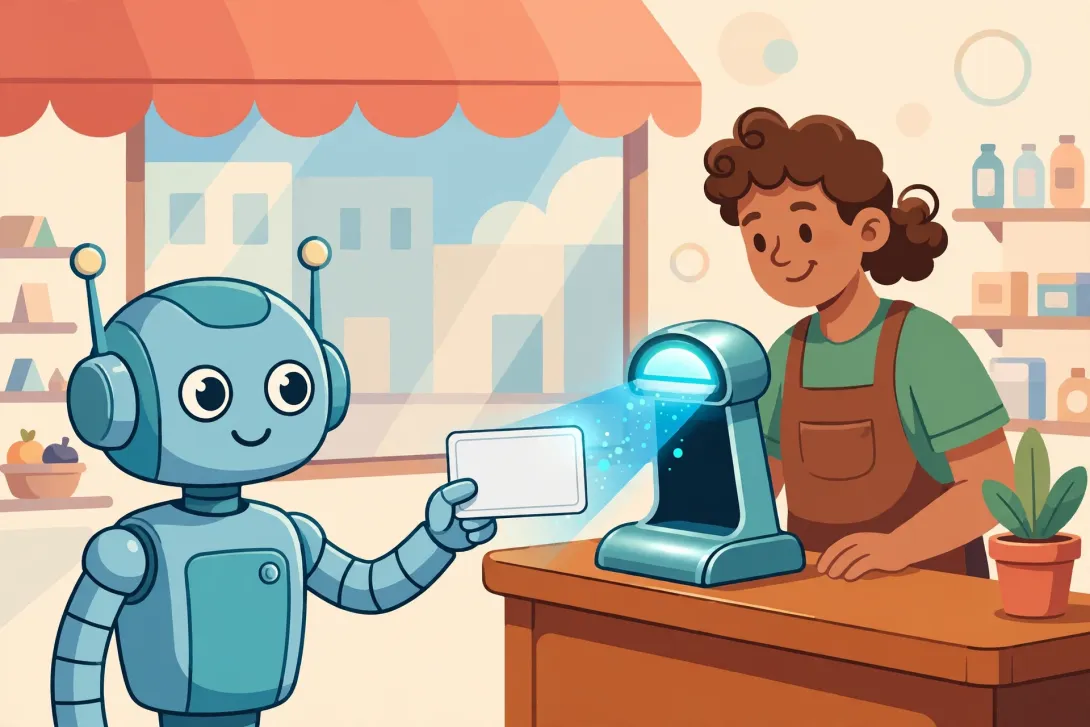
Cartoon illustration of a robot agent presenting a passport-style ID card to a shopkeeper at a storefront checkout while a scanner glows.

Your AI agent is about to walk into a store. Meta and Sierra want to make sure it knows how to knock.

On October 6, at Sierra Summit in San Francisco, Sierra and Meta announced the Personal Agent Protocol — PAP, an open standard for how a person's AI agent signs in to a business and gets a task done there. Sierra co-founders Bret Taylor, the former Salesforce co-CEO, and Clay Bavor published the announcement with founding partners Walmart, Stripe, Shopify, Genesys, Rocket, and Instinct.

The problem it solves is real. Today, an agent typically acts like a human visitor: clicking through pages, hoping the form works. "It is kind of chaos until such a standard exists," Taylor told CNBC. PAP gives the agent a proper door: sessions built on OAuth, the web's common sign-in standard. An agent can start as a guest for light tasks like checking stock; for account tasks, the customer signs in and chooses read-only or write access. The business decides what agents are allowed to do, and picks one of three routes: its existing website set up to be read by agents, its APIs over standards like MCP or OpenAPI, or its own conversational agent for tasks like a warranty claim.

The spec itself is still cooking. Sierra plans to publish v0.1 later in October, with a reference implementation and design workshops to follow. On October 9, Sierra published a draft nicknamed Poppy — companies publish one file at /.well-known/poppy.json — and named 35 more design partners, OpenAI among them. That is a notable evolution: OpenAI and Anthropic were conspicuously absent from the original announcement.

Payments are explicitly a future extension, not part of v0.1. Agent checkout is being addressed separately — by OpenAI's Agentic Commerce Protocol and Visa's Trusted Agent Protocol, among others. PAP answers "who is this agent and what may it do here?" and leaves "how does the money move?" to someone else.

The field is crowded — PAP, UCP, ACP, and TAP all cover different slices of the transaction, and the same companies keep appearing on several of them. But PAP's positioning is clever: it is less a rival than a layer beneath the others. If it gains traction, it becomes the plumbing through which personal agents browse, book, and interact with services on a user's behalf.

Watch the spec drop later this month. Standards wars are won by whoever ships the boring, working file first.


Rocky Mountain Madman LLC
AI Implementation
Meta
AI Product News
Enterprise AI
AI Policy

Ai Industry News

Anthropic's 16.8 Billion Dollar Quarter Still Was Not Fast Enough for the AI Trade

A cartoon robot accountant presents easels of stacked gold coins as a chart to animal investors in a mountain workshop.

Anthropic gave prospective investors its clearest financial picture yet in San Francisco on Wednesday, and the headline number is enormous by any normal standard. Multiple reports from the investor day, first reported by the Financial Times, put third-quarter revenue at 16.8 billion dollars, up roughly 45 percent from 11.6 billion dollars in the second quarter. The company also told attendees it was profitable on an adjusted basis for a second straight quarter and cash-flow positive in the quarter, ahead of a planned initial public offering in November.

  • Read more about Anthropic's 16.8 Billion Dollar Quarter Still Was Not Fast Enough for the AI Trade

Shopify Opens Its Billion-Listing Catalog to Any AI Agent a Shopper Brings

A cartoon robot shopping assistant carrying bags through a colorful online marketplace of storefronts, handing a package to a customer at a checkout counter.

Shopify announced on Tuesday, October 13, that shoppers can now connect almost any AI agent to their account on Shop, the company's order-tracking app, and let that agent browse and buy from a catalog of more than a billion listings. Until now, agentic checkout on Shopify needed a partnership, as Meta's Muse agent received in September. That gate is gone. The shopper brings the agent, the agent does the searching and comparing, and checkout still runs through Shop Pay inside the conversation.

  • Read more about Shopify Opens Its Billion-Listing Catalog to Any AI Agent a Shopper Brings

Nvidia Puts $250 Million of Compute Behind UK Research on Keeping AI Agents Safe

Cartoon illustration of robot safety engineers testing a small autonomous robot inside a clear protective dome in a university laboratory.

Nvidia announced on October 14 a five-year donation of computing resources valued at 250 million dollars to support research in the United Kingdom on the safety and security of agentic AI. The commitment works out to 50 million dollars in compute access per year, delivered through UK-based Nvidia Cloud Partners. Most of it is aimed at the wider UK safety research community, with a share set aside for three named efforts: the BOLD lab led by the University of Oxford, the SOFAIR lab led by University College London, and Imperial College London.

  • Read more about Nvidia Puts $250 Million of Compute Behind UK Research on Keeping AI Agents Safe

Pagination

  • First page « First
  • Previous page ‹ Previous
  • Page 1
  • Current page 2
  • Page 3
  • Page 4
  • Page 5
  • Page 6
  • Page 7
  • Page 8
  • Page 9
  • …
  • Next page Next ›
  • Last page Last »

Copyright © 2026 Rocky Mountain Madman LLC - All rights reserved

Developed and Designed by Rocky Mountain Madman LLC