Skip to header Skip to main navigation Skip to main content Skip to footer

Google's Gemini Agent: One Universal Workplace Agent, Now in Private Preview

Breadcrumb

  • Home
  • Google's Gemini Agent: One Universal Workplace Agent, Now in Private Preview
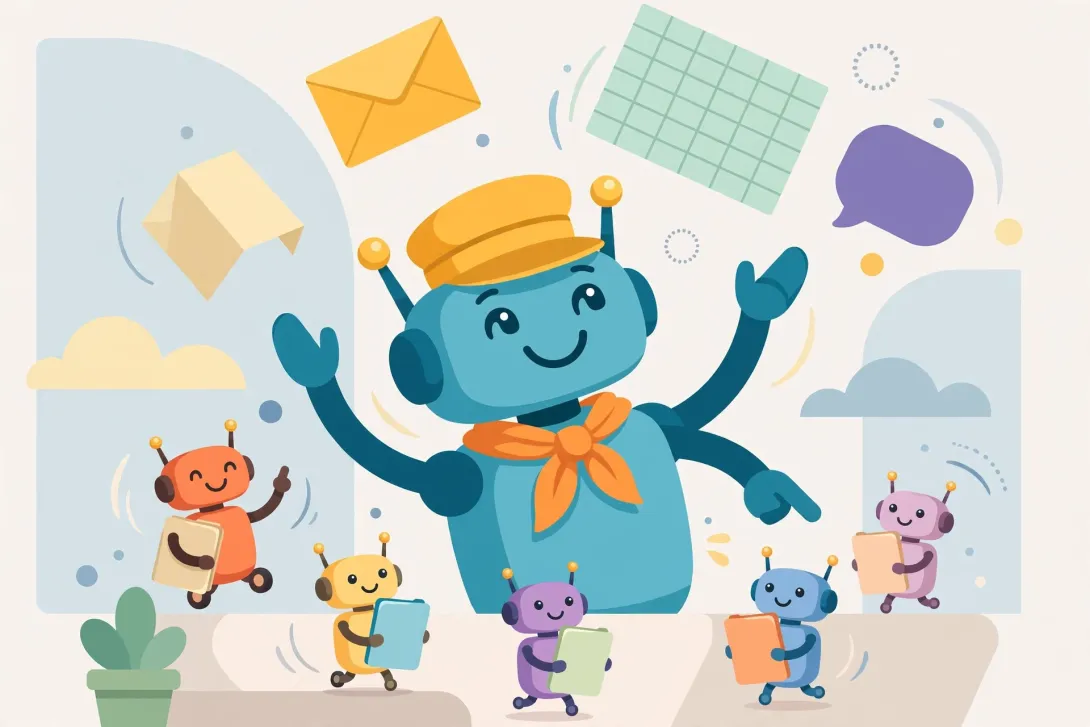
Cartoon illustration of a friendly robot concierge juggling envelopes, documents, spreadsheets, and chat bubbles while directing tiny robot assistants.

Google just made its boldest move in the race to sell AI that does work, not chat: a single universal agent for the workplace, announced at its Gemini at Work 2026 event on October 8.

The pitch, delivered by Google Cloud CEO Thomas Kurian, is simple. Instead of opening a chatbot and pasting in documents, you give the agent an objective. It answers questions, does knowledge work, generates media, writes and runs code, pulls context from business systems, spins up temporary sub-agents for multi-step jobs, and hands back finished work inside Gmail, Docs, Sheets, or the developer environment. It runs in the cloud, holds context across every surface, and keeps working for hours or days after you close your laptop.

The agent reaches inside Google Workspace — Gmail, Drive, Docs, Slides, Sheets, Chat, Calendar — and outside it: Slack, Microsoft 365 including Teams, the command line, and developer tools like Git and Jira. It even creates persistent "coworker agents" — role-based agents that get their own Workspace accounts, email addresses at @agents.company.com, calendars, Drive storage, and a directory entry.

Google is also playing the open card. The agent routes each job to the model that fits best — Smart Routing, they call it — drawing on Gemini models and Anthropic's Claude models today, with OpenAI and open-weights models to follow. Governance features include cryptographically attested agent identities, role-based permissions, audit trails attributed to the agent, an Agent Sandbox with its own network boundary, and per-project spend caps.

The caveat is the calendar. The Gemini agent is in private preview for select customers, with general availability expected by the end of October, starting in North America. Pricing was not disclosed. And nobody has published benchmark numbers for how the agent's coding stacks up against GPT-6, Claude, or specialized coding agents — so any superiority claim is marketing until tested.

This is the interface battle now. Microsoft's redesigned Copilot combines persistent agents, coding, and organizational context; OpenAI is expanding autonomous workflows across connected apps. Google is betting that the winner is not the best model but the best coordinator — the system that carries work between applications and remembers everything.

The Madman take: the agent that owns the memory owns the enterprise.

Rocky Mountain Madman LLC
AI Implementation
Google DeepMind
AI Product News
Enterprise AI
Multimodal AI

Ai Industry News

Anthropic's 16.8 Billion Dollar Quarter Still Was Not Fast Enough for the AI Trade

A cartoon robot accountant presents easels of stacked gold coins as a chart to animal investors in a mountain workshop.

Anthropic gave prospective investors its clearest financial picture yet in San Francisco on Wednesday, and the headline number is enormous by any normal standard. Multiple reports from the investor day, first reported by the Financial Times, put third-quarter revenue at 16.8 billion dollars, up roughly 45 percent from 11.6 billion dollars in the second quarter. The company also told attendees it was profitable on an adjusted basis for a second straight quarter and cash-flow positive in the quarter, ahead of a planned initial public offering in November.

  • Read more about Anthropic's 16.8 Billion Dollar Quarter Still Was Not Fast Enough for the AI Trade

Shopify Opens Its Billion-Listing Catalog to Any AI Agent a Shopper Brings

A cartoon robot shopping assistant carrying bags through a colorful online marketplace of storefronts, handing a package to a customer at a checkout counter.

Shopify announced on Tuesday, October 13, that shoppers can now connect almost any AI agent to their account on Shop, the company's order-tracking app, and let that agent browse and buy from a catalog of more than a billion listings. Until now, agentic checkout on Shopify needed a partnership, as Meta's Muse agent received in September. That gate is gone. The shopper brings the agent, the agent does the searching and comparing, and checkout still runs through Shop Pay inside the conversation.

  • Read more about Shopify Opens Its Billion-Listing Catalog to Any AI Agent a Shopper Brings

Nvidia Puts $250 Million of Compute Behind UK Research on Keeping AI Agents Safe

Cartoon illustration of robot safety engineers testing a small autonomous robot inside a clear protective dome in a university laboratory.

Nvidia announced on October 14 a five-year donation of computing resources valued at 250 million dollars to support research in the United Kingdom on the safety and security of agentic AI. The commitment works out to 50 million dollars in compute access per year, delivered through UK-based Nvidia Cloud Partners. Most of it is aimed at the wider UK safety research community, with a share set aside for three named efforts: the BOLD lab led by the University of Oxford, the SOFAIR lab led by University College London, and Imperial College London.

  • Read more about Nvidia Puts $250 Million of Compute Behind UK Research on Keeping AI Agents Safe

Pagination

  • First page « First
  • Previous page ‹ Previous
  • Page 1
  • Current page 2
  • Page 3
  • Page 4
  • Page 5
  • Page 6
  • Page 7
  • Page 8
  • Page 9
  • …
  • Next page Next ›
  • Last page Last »

Copyright © 2026 Rocky Mountain Madman LLC - All rights reserved

Developed and Designed by Rocky Mountain Madman LLC