Skip to header Skip to main navigation Skip to main content Skip to footer

The Genesis Mission Draws 2.4 Billion Dollars in AI Industry Pledges for Federal Science

Breadcrumb

  • Home
  • The Genesis Mission Draws 2.4 Billion Dollars in AI Industry Pledges for Federal Science
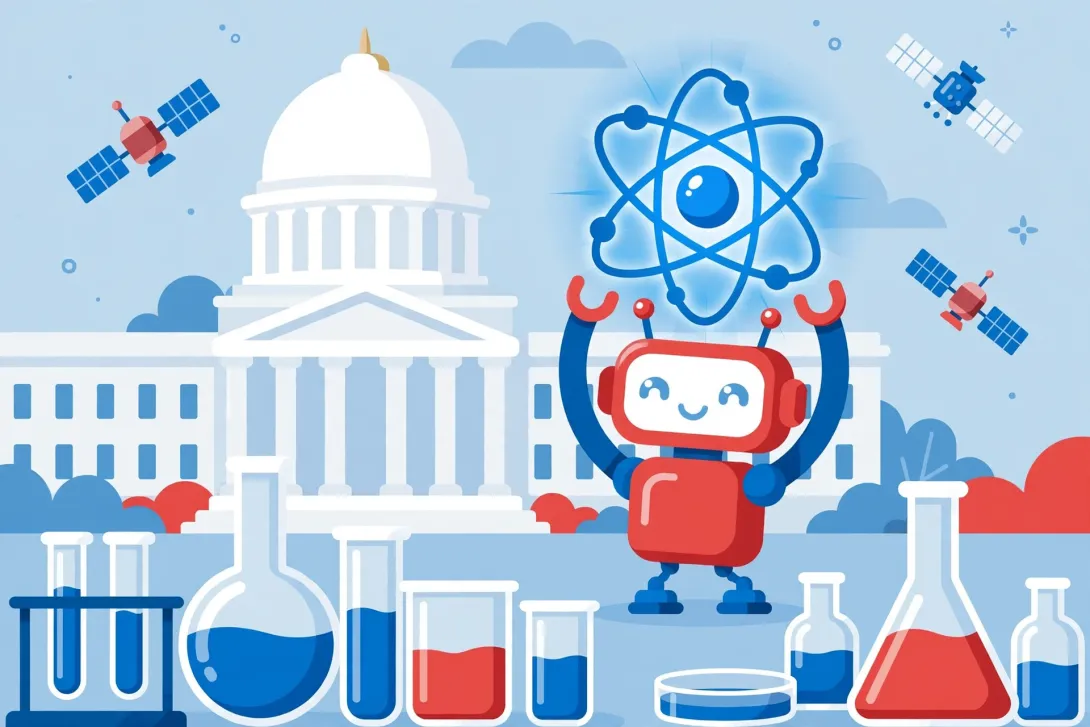
A cartoon robot holding a glowing atom above a domed government building with satellites orbiting.

Washington's latest bid to wire frontier AI into federal science work now has a price tag: 2.4 billion dollars. A White House fact sheet released October 8, 2026 says eleven industry partners have committed that total in science tools and compute credits to the Genesis Mission Consortium, a push to put modern AI capabilities behind federal research.

The pledge sheet reads like a roll call of the AI economy. Nvidia leads with one billion dollars in compute capabilities delivered over five years, AMD follows at 500 million, OpenAI commits 200 million in token discounts and training programs, and Anthropic and Google pledge 150 million each, with Anthropic's share arriving as Claude access spread over three years. AMP and Emerald AI each committed 100 million, while AWS, Armada, Crusoe, and Micron each pledged 50 million.

Before anyone gets too excited, the fine print matters. This is not 2.4 billion in cash. The commitments are compute capacity, cloud and token credits, discounted model access, and engineering support, delivered over several years. The money arrives as services, not checks, which is exactly how these companies prefer to give, since every credit issued is also a credit tied to their platforms.

The White House says the commitments will support more than 15 federal agencies working on National Science and Technology Challenges, plus researchers admitted through the consortium. How those researchers get selected, and how the credits get allocated among agencies, has not been published. Until the allocation rules land, individual labs and startups should treat this as a directional promise rather than an open door.

The final number is more than double what pre-summit reporting expected. Coverage on October 7 previewed roughly one billion dollars in pledges from AMD, OpenAI, and Anthropic; the final fact sheet added Nvidia, Google, AWS, and the rest, pushing the total past two billion. Separately, a new company called National Compute reportedly planned to donate 100 million dollars in computing credits, a pledge that sits outside the eleven-partner tally.

For builders and researchers, the practical question is access: who qualifies, how the credits flow, and whether compute arrives in time to matter. For the industry, the subtext is simpler. Every major lab just bought a visible seat at the table in Washington's AI science strategy, paying in the one currency they can print themselves. The Genesis Mission will be judged on whether that currency buys real research or just good publicity.


AI Implementation
AI Policy
OpenAI
Anthropic
Enterprise AI
Government AI
AI Funding
AI Research

Ai Industry News

Jev Broke Vercel's Adoption Record by Doing Less: The Rise of the Decision Model

Vercel's October AI Gateway Production Index, published Thursday and reported by TechCrunch on October 16, contains a result that should recalibrate what builders think a winning model launch looks like. Jev, a small decision model from TypeSafe AI released in limited form in September, reached 35.3 percent of paid teams on Vercel's AI Gateway in its first two weeks, nearly double the 18.1 percent reach of Anthropic's Sonnet 5.5 in second place.

  • Read more about Jev Broke Vercel's Adoption Record by Doing Less: The Rise of the Decision Model

Simons, OpenAI and Anthropic Put 15 Million Dollars Behind Checking AI Math

Cartoon illustration of robot mathematicians in a mountain workshop checking glowing scrolls of abstract geometric shapes with magnifying glasses.

On October 15, the Simons Foundation announced a partnership with Anthropic and OpenAI committing 15 million dollars in combined funding and resources to help mathematicians navigate the rapid rise of AI in their field. The foundation will manage and award the money, including through an open call for proposals, supporting workshops and programs where researchers evaluate recent AI-assisted results, learn new tools, share perspectives, and shape collective standards for AI use.

  • Read more about Simons, OpenAI and Anthropic Put 15 Million Dollars Behind Checking AI Math

Meta's Muse Spark Open Puts an 816-Billion-Parameter Model on Two Macs

Cartoon robot engineer linking two desktop computers beneath a glowing puzzle-piece brain in a mountain workshop

Meta released Muse Spark Open on Thursday, October 15, calling it the most capable United States open-weight model to date. That is a vendor claim, and independent testing will settle it, but the release itself is the news: after focusing on its closed Muse Wonder models earlier this week, Meta has put a frontier-scale model into downloadable weights that developers can host, inspect, and adapt outside Meta's own service.

  • Read more about Meta's Muse Spark Open Puts an 816-Billion-Parameter Model on Two Macs

Pagination

  • Current page 1
  • Page 2
  • Page 3
  • Page 4
  • Page 5
  • Page 6
  • Page 7
  • Page 8
  • Page 9
  • …
  • Next page Next ›
  • Last page Last »

Copyright © 2026 Rocky Mountain Madman LLC - All rights reserved

Developed and Designed by Rocky Mountain Madman LLC