Skip to header Skip to main navigation Skip to main content Skip to footer

DeepSeek Open-Sources a Super-Agent That Works Without Being Asked Twice

Breadcrumb

  • Home
  • DeepSeek Open-Sources a Super-Agent That Works Without Being Asked Twice
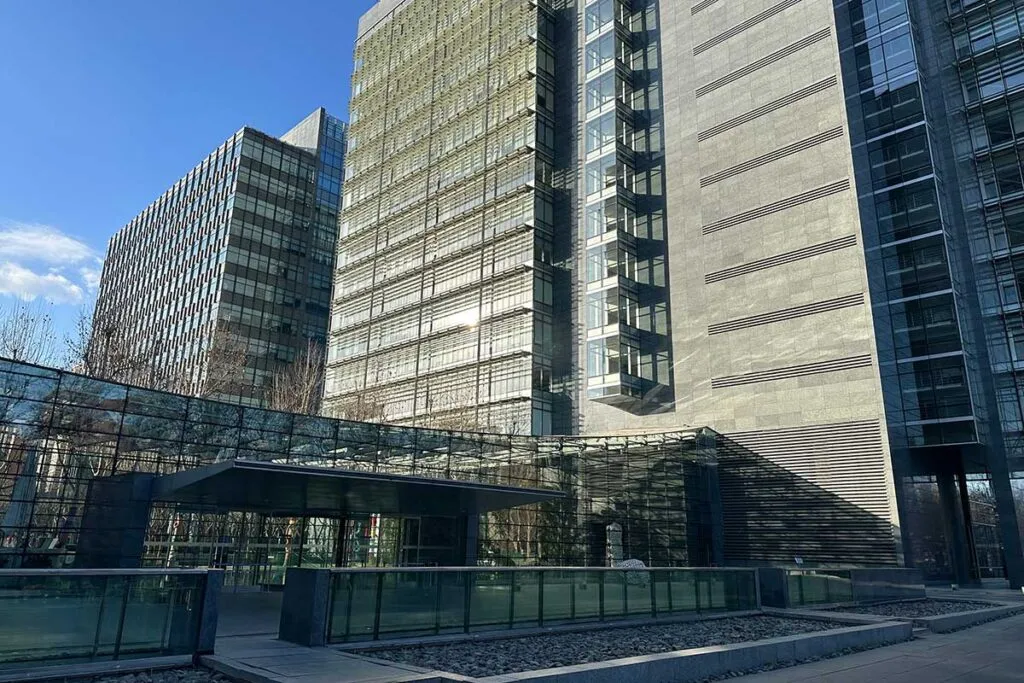
Photograph of the offices of DeepSeek in Beijing, showing modern glass office towers and a glass entrance pavilion.

DeepSeek's Harness team has published dsh-superagent-prototype on GitHub under the MIT license, a research prototype of a coding agent that does not wait to be prompted in a chat window. Released on October 31, with a design article, "Exploring Super-agent Design," following on November 1, the bundle for DeepSeek Harness listens to GitHub, and optionally to Feishu, and turns requests from authorized people into work items and pull requests. The README is refreshingly blunt: this is research code for reference only, not an official product, and much of its engineering was done by coding agents themselves.

The architecture is the interesting part. A Router layer keeps the broader context and handles communication, while individual Workers execute separate tasks in parallel, each in its own session and its own directory. Work only starts when an allowed person asks, or when a rule the team itself wrote permits it. Permissions sit in a Mandate enforced by the host, and the docs state plainly that messages, comments, and quoted documents are inputs to a decision and cannot change those permissions. That is prompt-injection discipline written into the design, not bolted on afterward.

The stated philosophy is to take as little human attention as possible and give as much value as possible. The agent confirms a request once, stays quiet while it works, and speaks again only when a result is ready, a decision is needed, or it cannot finish. Practitioners should also read the warnings: worker sessions run commands without approval as the operator's operating-system user, so the authors advise an isolated machine, a dedicated GitHub account for the agent, a short allow list, and a record-only mode for proactive work at first. There are no benchmarks and no productivity claims. The value here is a working blueprint for team agents, published openly by a lab better known for models.

The infrastructure those agents run on faces a vote tomorrow. Ballotpedia reported on November 2 that voters in 10 states will decide 41 local ballot measures affecting data center policy on November 3: a yes vote on 28 would limit development, through bans or moratoriums, while 13 would facilitate it. Ohio alone decides 21 measures, followed by Illinois with seven. The six measures already decided this year all favored greater limits. Whatever model wins this week, its compute still has to get permitted, powered, and past the neighbors.

One caution from the weekend's other headline: a screenshot posted November 1 claimed the name Claude Mythos 5.5 in the source code of Anthropic's own Mythos page, but rechecks on November 2 found the page reading 5.1 again, with no announcement, pricing, or benchmarks from Anthropic. Treat leaked names as rumors until a lab publishes. The practical lesson from all three stories is the same: build on code you can inspect and votes that have actually been counted, not on screenshots of what might ship next.


Rocky Mountain Madman LLC
DeepSeek
Open Weights
AI Safety
Enterprise AI
AI Implementation
AI Policy
China AI

Ai Industry News

Goodfire's Inside-Out Monitors: Reading an Agent's Mind Beats Reading Its Transcript

Cartoon illustration of an airport-security-style scanning arch inspecting a friendly robot's glowing inner machinery.

The standard way to keep an AI agent in line is to have a second AI read over its shoulder. Goodfire, the interpretability startup, has just shipped an alternative: monitors that watch what is happening inside a model's calculations while it works, instead of auditing the words it produces afterward.

  • Read more about Goodfire's Inside-Out Monitors: Reading an Agent's Mind Beats Reading Its Transcript

Google's EmbeddingGemma 2: One Open Model for Text, Code, Images, and Audio

Cartoon illustration of a glowing magnet drawing documents, code brackets, photos, and sound waves into a single swirling vortex.

Buried under this week's frontier-model headlines, Google DeepMind shipped something many working developers will get more practical use out of than any trillion-parameter announcement: EmbeddingGemma 2, a 740-million-parameter open embedding model released under Apache 2.0. It maps text, code, images, video, and audio into a single shared vector space, carries an 8K-token context window, and ships with modular text, vision, and audio encoders designed for on-device deployment.

  • Read more about Google's EmbeddingGemma 2: One Open Model for Text, Code, Images, and Audio

Rivals at One Table: OpenAI, Anthropic, and DeepMind Coordinate on AI Safety

Cartoon illustration of three distinct robots shaking hands around a round table, one holding a shield, in a warm cooperative scene.

In a week full of model launches, the most unusual announcement involved no model at all. OpenAI, Anthropic, and Google DeepMind have confirmed they spent several weeks coordinating on AI safety, jointly unveiling cyber-focused AI models, safeguards, and access programs developed collaboratively across the three labs. One report describes a formally announced joint standards body publishing common testing protocols for frontier models.

  • Read more about Rivals at One Table: OpenAI, Anthropic, and DeepMind Coordinate on AI Safety

Pagination

  • First page « First
  • Previous page ‹ Previous
  • …
  • Page 24
  • Page 25
  • Page 26
  • Page 27
  • Page 28
  • Page 29
  • Current page 30
  • Page 31
  • Page 32
  • Next page Next ›
  • Last page Last »

Copyright © 2026 Rocky Mountain Madman LLC - All rights reserved

Developed and Designed by Rocky Mountain Madman LLC