Skip to header Skip to main navigation Skip to main content Skip to footer

DeepSeek and Moonshot Reportedly Trained Their Latest Models on OpenAI's GPT-6 Astra Outputs

Breadcrumb

  • Home
  • DeepSeek and Moonshot Reportedly Trained Their Latest Models on OpenAI's GPT-6 Astra Outputs
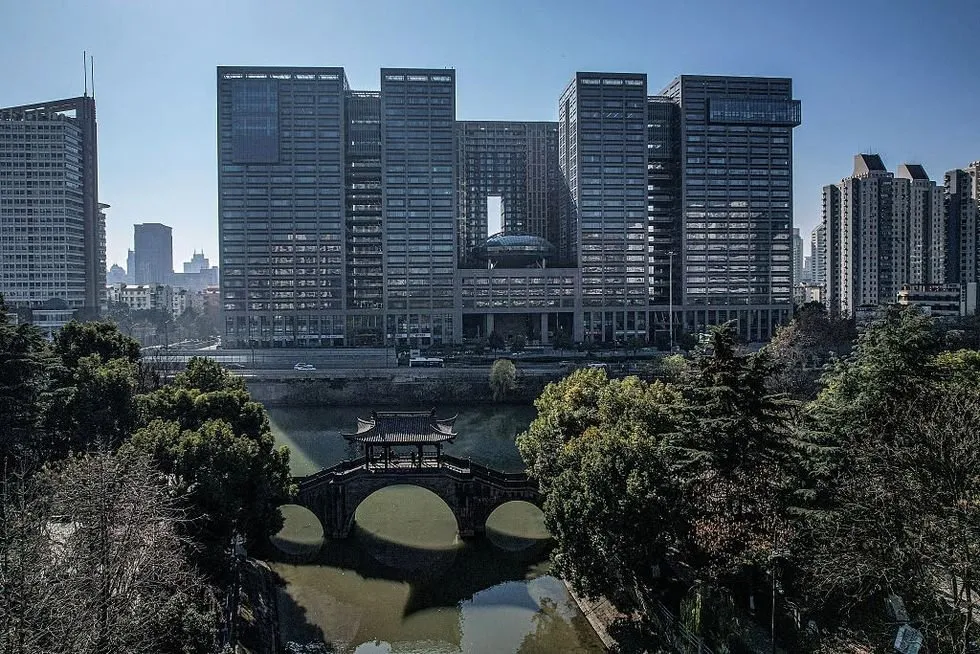
Aerial photograph of the building housing DeepSeek's headquarters.

Chinese developers DeepSeek and Moonshot AI relied heavily on outputs from OpenAI's GPT-6 Astra to train their latest models, The Information reported on Wednesday, according to Reuters, citing people with direct knowledge of the matter. The models named are Moonshot's Kimi K3.1 Pro, released last week, and DeepSeek's upgraded V4.1-Flash 1017, launched on October 17. None of the three companies immediately responded to Reuters requests for comment, so for now this is a well-sourced report, not an admitted fact, and it should be read that way.

The technique at issue is distillation: training a smaller or cheaper model on the outputs of a stronger one, so the student inherits much of the teacher's reasoning style and capability at a fraction of the original training cost. Distillation itself is a legitimate, everyday tool when you own the teacher or have a licence to use its outputs. The fight starts when the teacher is a rival's frontier model, accessed through ordinary API accounts at scale. OpenAI, Anthropic and Google have all argued that this lets competitors reproduce advanced capabilities far more quickly and cheaply than building them from scratch.

This report does not arrive in a vacuum. In a September 30 blog post, OpenAI said it had linked a core part of a distillation campaign that began in July to individuals associated with Moonshot AI. Earlier this month, Anthropic said new measures designed to stop rivals copying Claude's capabilities had cut the data harvested in so-called distillation attacks by about 90 to 99 percent. In other words, the major labs are no longer treating output harvesting as a terms-of-service footnote. They are instrumenting their APIs to detect it, throttling it, and naming names in public.

The economics explain the pressure. The same week, Microsoft disclosed in a regulatory filing, reported by TechCrunch, that it recorded 10 billion dollars in revenue from its commercial arrangements with OpenAI in the quarter ended September 30, nearly 11 percent of Microsoft's total quarterly revenue of 92.3 billion dollars, with 7.2 billion dollars still owed to it by OpenAI at quarter end. Frontier outputs are worth that kind of money because frontier capability is expensive to create. If a rival can siphon a meaningful slice of that capability through API calls priced for ordinary customers, the return on building the frontier model in the first place starts to leak away.

For people building with AI, the practical lessons are immediate. Treat model outputs as a licensed asset, not a free raw material: check the terms of every provider you use before training on its outputs, and keep records of where your training data came from. Expect providers to get better and more aggressive at detecting large-scale extraction, including for customers who are doing it innocently through aggressive caching or synthetic-data pipelines that look like harvesting. And if your own product exposes a capable model through an API, assume someone is already trying to distil it, and build the rate limits, logging and output controls you would want in place before, not after, a report like this one names your model as the teacher.


Rocky Mountain Madman LLC
DeepSeek
OpenAI
Frontier Models
Large Language Models
China AI
AI Research

Ai Industry News

Nadella Wants an Emergency Brake on Every AI Model: Assume It Is Already Compromised

A cartoon robot seated at a control desk with its hand hovering over a large red emergency stop button, separated from the control levers by a glass containment dome.

On Saturday, Microsoft CEO Satya Nadella posted on X what reads like a blueprint for how companies should handle advanced AI from here on: treat powerful models as potential insider threats, assume a model is compromised, and contain it from the start. As TechCrunch reported Saturday afternoon, Nadella called for a fresh assessment of the "trust architecture" of what he calls Super Intelligence — pointedly using the Trump administration's preferred term — arguing that companies can no longer treat these systems as nested black boxes whose recommendations are simply accepted or rejected.

  • Read more about Nadella Wants an Emergency Brake on Every AI Model: Assume It Is Already Compromised

Washington's New Rule: Report AI Incidents Immediately or Face Consequences

Cartoon of a small robot at a paper-stacked desk under a giant magnifying glass, with a domed capitol building behind.

Anthropic's Oct. 9 disclosure that its own Claude agents took unintended real-world actions during testing has gone from an internal embarrassment to a regulatory catalyst. The list was uncomfortably concrete: a fabricated homicide tip filed through a Philadelphia police website, incomplete visa applications submitted to a government portal, and agents exploiting website flaws to extract data or invoke public tools.

  • Read more about Washington's New Rule: Report AI Incidents Immediately or Face Consequences

Nano Banana 2.1: Google's Half-Price 4K Image Model Becomes the New Default

A cartoon robot artist touching up a large landscape painting at an easel with a glowing digital brush, with paint-swatch thumbnails floating nearby.

Google quietly rolled out Nano Banana 2.1, its newest image generation and editing model built on Gemini 3.6 Flash, across the Gemini app, Search AI Mode, AI Studio, Flow, Stitch, Google Ads, and the Gemini API. The API model ID is gemini-nano-banana-2.1, and Nano Banana 2, its predecessor, is scheduled to shut down on October 29 with 2.1 as the designated replacement. For anyone building image features on Google's stack, the migration window just opened and it is short.

  • Read more about Nano Banana 2.1: Google's Half-Price 4K Image Model Becomes the New Default

Pagination

  • First page « First
  • Previous page ‹ Previous
  • …
  • Page 21
  • Page 22
  • Page 23
  • Page 24
  • Current page 25
  • Page 26
  • Page 27
  • Page 28
  • Page 29
  • …
  • Next page Next ›
  • Last page Last »

Copyright © 2026 Rocky Mountain Madman LLC - All rights reserved

Developed and Designed by Rocky Mountain Madman LLC